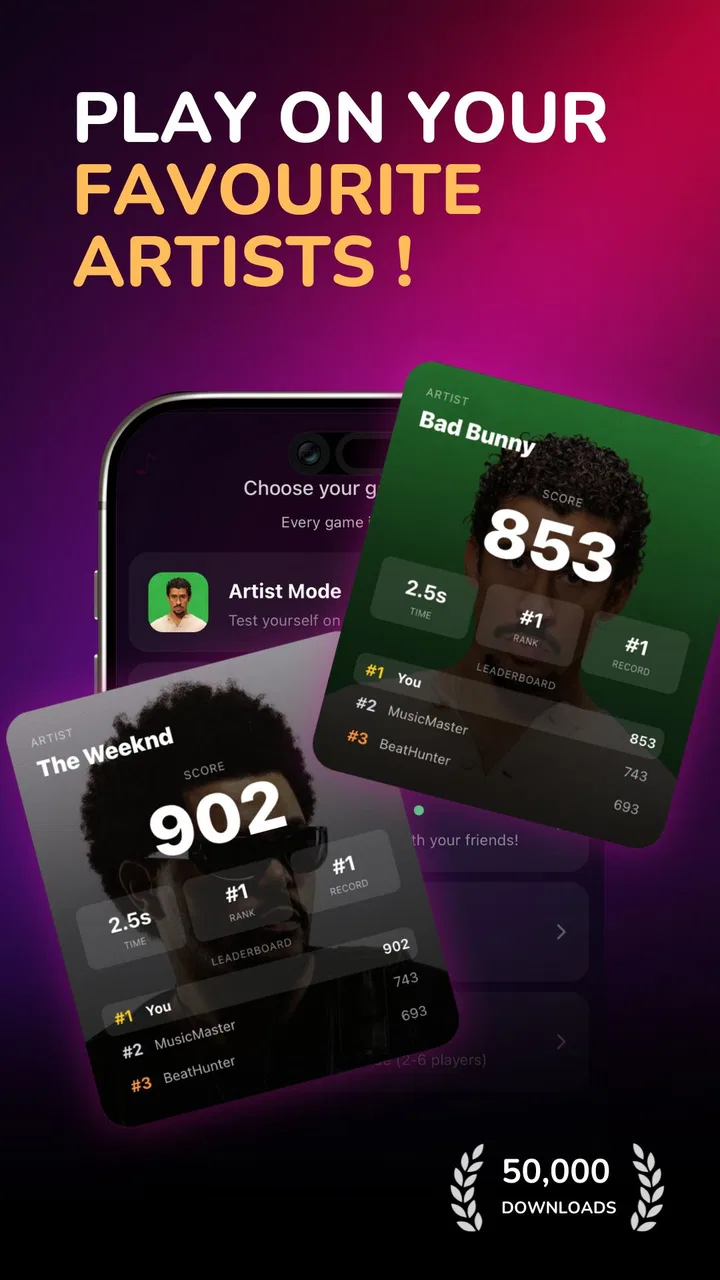
MeloClash - Music Quiz
- 0.0
- Rating
- 50.00K
- Installs
- Free
- Price

 Analysis by App-foxy
I usually know within a few sessions whether a music game has more to offer than a pleasant first impression. MeloClash made a good opening case because it turns listening into a quick recognition challenge: a song starts, I try to identify the artist or track, and the pressure comes from answering before somebody else does. That simple setup is easy to understand, but it also gives the game a useful social quality that ordinary music streaming does not provide.
Developed by MeloClash, this free music game is aimed at people who enjoy testing their knowledge of familiar artists and songs. It is listed for Everyone, runs on Android from version 6.0 onward, and reached version 3.2 after its release on January 19, 2026. The game has passed 50 thousand installs, which gives it a modest but meaningful community rather than the feeling of an entirely empty experiment.
My main question was not whether the blind-test idea worked for an evening. It clearly does. The more important question was whether I would still want it on my phone after the novelty of the first rounds disappeared. My answer is qualified: it can earn that space if I treat it as a short, repeatable music challenge, but it is less convincing for anyone looking for a deep rhythm game, a complete music library, or a solo experience with a long progression system.
You May Also Like

 AccuWeather: Weather Radar
AccuWeather Review: A Quick, Clear Forecast for Everyday Decisions
For everyday plans, the best forecast is the one you can understand quickly. AccuWeather makes rain timing, radar, and local conditions easy to act on, with a few trade-offs.

 Hill Climb Racing
Why Hill Climb Racing Still Turns Crashes Into One More Run
A tiny car, a bumpy hill and one more upgrade: Hill Climb Racing keeps resurfacing because its simple chaos makes every near-miss feel personal.

 AliExpress - Shopping App
AliExpress Makes Global Shopping Feel Personal, but Shoppers Bear the Risk
AliExpress turns a global marketplace into a pocket-sized discovery engine. Its reach is useful, its shopping loop compelling, and its trade-offs easy to miss.

 Lords Mobile: Kingdom Wars
Lords Mobile Is a Kingdom-Building Routine, Not a Quick Match
A case-by-case verdict on the building, battles, device demands, and social commitments that make Lords Mobile rewarding for some players and exhausting for others.

 PDF Scanner app - TapScanner
TapScanner Makes Paperwork Easier to Capture, Check, and Share
TapScanner makes scanning with a phone feel less like a rescue operation and more like a dependable step in getting work done. Its capture tools are useful, though not flawless.

 Block Blast!
 Shows How Much a Puzzle Game Can Leave Out
A quiet grid game shows why puzzle players increasingly value instant clarity, repeatable skill and low-pressure play—and where the genre still needs to catch up.
More From Our News Desk
View All News


How the first sessions feel
The strongest part of the first week is how quickly the game gets to its central pleasure. There is no need to learn an elaborate control scheme. I listen, make a judgment, and discover whether my memory is as good as I thought. That low entry barrier makes it suitable for a casual group, including people who would normally avoid games because they do not want tutorials, complicated menus, or demanding reflexes.
A useful way to play is to begin with a relaxed round rather than immediately treating every question as a competition. I found that the first few attempts reveal what kind of listener I am. Some songs are recognized almost instantly from an opening sound, while others require me to wait for a vocal clue, a familiar instrument, or a particular production style. The game therefore tests more than simple title recall; it also exposes how closely I actually listen to the artists I claim to know.
This makes it especially effective at a small gathering. Imagine a few friends waiting for food or sitting together after a long day. Instead of passing around a phone to show individual playlists, one person can start a challenge and let the music create the conversation. Wrong answers are often as entertaining as correct ones, because somebody will confidently name the wrong artist and then explain why the clue sounded familiar. That social reaction is a genuine strength, and it is more memorable than playing a conventional quiz alone.
The game also works in shorter gaps. I can use it when I have only a few minutes, because a music quiz does not demand the same uninterrupted attention as a longer adventure or strategy session. That convenience matters for a phone game. It gives MeloClash a clear role: a quick test between tasks, a party icebreaker, or a lightweight way to compare music knowledge with friends.
Still, the first-week appeal depends heavily on whether the available musical material feels familiar and enjoyable to the player. Someone who listens broadly may appreciate the challenge of being surprised. Someone with a very specific taste may encounter fewer satisfying questions if the selection does not align with their favorite artists. Since the core loop is recognition, personal music preferences have a larger effect here than they would in a game built around original levels or characters.
I also would not confuse this with a rhythm game. The pleasure comes from knowing the music, not from tapping accurately to a beat or performing a song. That distinction is important when deciding whether to install it. If I want timing mechanics, visual effects, and a strong sense of mechanical progression, another music-focused game would probably suit me better. MeloClash is closer to a competitive listening exercise with game structure around it.
Why the simple format works socially
The blind-test format gives every player a chance to contribute, even when skill levels differ. One person may know current artists, another may recognize older tracks, and a third may identify a song from only a few seconds because of an unusual voice. That variety prevents the strongest player from automatically dominating every type of question.
My practical tip is to use the game as a conversation starter rather than as a serious examination. Ask players why they chose an answer, let them explain the memory connected to a song, and avoid turning every miss into a complaint about difficulty. The best moments come when the quiz sends the group into a discussion about concerts, childhood favorites, guilty pleasures, or songs that everyone knows but nobody can name.
There is also a small strategic lesson in not answering too quickly. Immediate recognition feels rewarding, but a rushed guess can waste a good opportunity when the opening is deliberately ambiguous. I found it more useful to separate confidence from familiarity: knowing that a song sounds familiar is not the same as knowing the artist. That habit makes later rounds more interesting and gives experienced players something to improve beyond memorizing answers.
What remains useful after the novelty
After the first burst of discovery, the game’s lasting value depends on whether I enjoy the act of testing myself repeatedly. The format does not transform into a different genre over time. Its durability comes from changing musical prompts, changing opponents, and the simple desire to beat a previous performance or prove a point to friends.
That can be enough for a regular habit. I can imagine opening it once or twice a week before a music-focused social event, using it as a warm-up, or returning when I want a low-effort challenge. It is not the kind of app I would necessarily play continuously for a long session, but that is not a serious flaw. Short games often survive longer on my phone because they fit around real life instead of demanding a large block of time.
The month-to-month question is whether the music remains fresh. A blind test loses some of its tension when I remember the same prompts too easily. On the other hand, repeated exposure can create a different kind of satisfaction: I may recognize an artist more quickly, notice details I missed before, or improve at distinguishing similar performers. The game therefore has two possible long-term paths. It can become repetitive if I only chase familiar answers, or it can become a listening exercise if I pay attention to how recognition happens.
For that reason, I would use it alongside my normal music habits rather than as a replacement for them. I might listen to a playlist first, then play a few rounds later and see which songs stayed in my memory. I could also use it before a themed gathering, choosing a session as a friendly test of who knows the selected artists best. This workflow gives the game a purpose and reduces the feeling that I am opening it without a reason.
The free entry helps with that occasional use. I can try the experience without committing money immediately, which is appropriate for a game whose appeal is strongly tied to personal taste and social context. There are in-app purchases ranging from $3.49 to $17.99 per item, so I would approach spending carefully. A purchase may make sense for someone who plays often and finds a specific paid option valuable, but I would not pay simply to solve the basic question of whether the blind-test format suits me.
That pricing range also affects how I judge the game’s long-term value. A free music quiz can be easy to keep installed because it costs nothing to revisit. Once optional spending enters the picture, I expect a clear reason to buy. My advice is to play enough free sessions to see whether the game becomes part of your routine. If it remains an occasional curiosity, there is little reason to spend; if it becomes the group’s regular music challenge, the decision becomes more personal.
Who is most likely to keep playing
I think the best long-term audience is a group of friends with overlapping but not identical music knowledge. The differences create debate, while the overlap ensures that answers feel possible. Music fans who enjoy identifying artists from small clues may also find a satisfying repeatable challenge here, especially if they like comparing instinctive recognition with deliberate listening.
It is less suitable for someone who needs a strong solo campaign, a story, collectible characters, or a large set of changing mechanics. It may also disappoint players who want to discover new music in a streaming-service sense. A quiz can remind me of songs and artists, but its purpose is to test recognition, not to replace an organized listening platform.
Parents and mixed-age groups may appreciate the Everyone rating, but the actual enjoyment will still depend on whether the music feels appropriate and familiar to the people playing. The age label makes the game broadly accessible; it does not guarantee that every participant will connect with every question. I would choose it for a family or group setting only after considering the musical tastes in the room.
Where the maintenance burden appears
A game like this has a lighter maintenance burden than a large online title because I do not need to manage a complicated character build, memorize a long ruleset, or reserve regular time for extended sessions. The main maintenance is mental: keeping the app interesting by changing how I use it and by accepting that not every round will feel equally rewarding.
The social side requires more effort than the controls. If I always play alone, the experience can become a repeated guessing exercise. If I invite different people, compare reactions, and use the quiz as part of a larger evening, it gains more life. In that sense, MeloClash is not entirely self-sustaining. Its strongest use depends on the player supplying context.
There is also a practical maintenance habit I would recommend: do not judge the entire game from one disappointing session. Music quizzes are unusually sensitive to mood. A set of artists I do not know can make the game feel flat, while a session built around familiar favorites can be lively. I would return at a different time or play with another group before deciding that it has no place on my phone.
At the same time, I would avoid forcing a daily routine. Turning a casual music challenge into homework can expose its limited core loop too quickly. Unlike a game designed around daily missions or escalating levels, this one benefits from breathing room. Occasional use preserves the feeling of testing memory instead of grinding through the same activity.
Device compatibility is reasonably broad because the game supports Android from version 6.0. That makes it accessible to people who are not using a recent phone, although the quality of any music game still depends on practical listening conditions. In a noisy room, with weak speakers, or while several people are talking, the challenge can become unclear for reasons unrelated to musical knowledge. Headphones may help for solo play, while a speaker is more useful when the whole group needs to hear the clue.
That choice of audio setup is a non-obvious part of the experience. Headphones improve concentration and reduce arguments about whether a sound was audible, but they remove some of the shared atmosphere. A speaker makes the game more social but can blur quieter details. I would use headphones when practicing recognition and a clear shared speaker when hosting a group round.
What can cause fatigue
The biggest source of fatigue is repetition in the central action. Listening and guessing is appealing because it is immediate, but it does not offer endless mechanical variety. If I play too many rounds in one sitting, I start focusing less on the music and more on the pattern of the quiz itself. That is the point where I would stop rather than continue out of habit.
Difficulty can create a second problem. Questions that are too obvious become routine, while questions based on artists I do not know can feel arbitrary. The ideal round sits between those extremes, giving me enough information to reason without making the answer automatic. A group with very different music backgrounds may struggle to find that balance, because a clue that is obvious to one player may be completely unfamiliar to another.
Competitive pressure can also change the mood. A quick answer feels exciting when everyone is laughing, but it can become irritating if one player dominates or if the group treats every miss as evidence that somebody has poor taste. I would keep the tone informal and rotate who starts the round when possible. The game is at its best when winning is a bonus rather than the only reason to participate.
Another limitation is that recognition is personal. A player can be genuinely knowledgeable and still perform poorly with unfamiliar genres. That means results should not be treated as a universal ranking of music expertise. MeloClash measures familiarity with the material presented, plus speed and confidence. Understanding that trade-off prevents the game from feeling unfair when the questions do not match a player’s listening history.
The optional purchase structure may add friction for people who prefer a completely unrestricted free experience. Because the game is free to start but offers individual purchases from $3.49 up to $17.99, I would pay attention to what is available before making it part of a group’s regular routine. The right approach is to decide whether the free version already provides enough replay value, then consider spending only when the benefit is clear and recurring.
When another option is better
I would choose a music streaming service when my main goal is discovering artists, building playlists, or listening without interruption. I would choose a rhythm game when I want physical interaction, timing challenges, and visible skill progression. I would choose a traditional trivia game when I want questions across history, science, film, and general knowledge rather than a focused test of music memory.
MeloClash makes more sense when the desired activity is specifically “listen, recognize, and compare.” That narrow focus is both its identity and its boundary. It does not need to compete with every music app because it serves a different moment: the moment when I want music to become a shared challenge instead of background sound.
For a solo player, I would recommend treating it as a short practice tool. Try to identify the artist before the most obvious clue arrives, notice which voices or production styles confuse you, and stop once concentration drops. For a group, I would prepare the setting first: use a speaker everyone can hear, keep the rounds short, and invite explanations for wrong answers. Those small choices make the experience feel more deliberate and reduce the chance that the quiz turns into noise.
My long-term verdict
After looking past the initial amusement, I see MeloClash as a focused companion rather than a game that will occupy every spare hour. Its lasting appeal comes from music itself, social comparison, and the convenience of quick sessions. The developer has kept the concept clear: this is a music quiz built around recognizing songs and favorite artists, not a larger game pretending to be one.
I would keep it installed if I regularly spend time with friends who enjoy music debates, or if I like testing my own recognition skills in short bursts. The free starting point makes that decision easy, and the broad Everyone rating plus Android 6.0 support means the practical barrier to trying it is low. I would be more cautious about purchases until I had established a real habit, especially because the optional items can cost from $3.49 to $17.99 each.
I would skip it if I need a deep solo progression system, a constantly changing set of mechanics, or a tool for discovering music rather than identifying it. I would also avoid making it a daily obligation. The game’s best long-term rhythm is occasional but intentional use: a few rounds before a gathering, a friendly rematch after discovering new artists, or a quick test when I want to turn listening into play.
My final recommendation is simple: try it for the social moments it creates, not for promises of endless content. When the music matches the group and the session stays short, the blind-test format remains genuinely fun after the first week. When played too often or without the right audience, its narrow loop becomes visible. That makes MeloClash worthwhile for music-loving casual players, but only if its role stays clear and its novelty is supported by real listening habits.
FAQs for MeloClash - Music Quiz
01What is MeloClash - Music Quiz and how does it work?
MeloClash - Music Quiz is a music-trivia game built around identifying songs, artists, genres, or musical details as quickly and accurately as possible. After starting a round, you listen to short audio clips or review quiz prompts and choose the answer you believe is correct. The game is designed for quick sessions and competitive play, making it suitable for testing your music knowledge alone or against other players.
02Can I play MeloClash - Music Quiz offline?
Offline availability may depend on the specific game mode and the version installed on your device. Some quiz content may require an internet connection to load music clips, synchronize progress, update question databases, or support multiplayer features. Before traveling or playing without mobile data, open the app while connected to Wi-Fi and check whether the desired mode remains accessible after disconnecting.
03Does MeloClash - Music Quiz include multiplayer or competitive features?
MeloClash is primarily designed around musical competition, so players can generally expect features focused on comparing knowledge and scores. Depending on the current release, this may include head-to-head challenges, rankings, timed rounds, or other competitive formats. An internet connection and an account may be required for online functions, while available matchmaking options can vary by region and app update.
04Is MeloClash - Music Quiz free to download and play?
The app may be available to download without an upfront purchase, but free access does not always mean that every feature is unlimited. Music quiz games commonly include advertisements, optional purchases, premium content, or limits on attempts and special modes. We recommend checking the Google Play Store or Apple App Store listing for the latest pricing, subscription details, and in-app purchase information before downloading.
05What permissions and device requirements should I consider before installing it?
Before installing MeloClash - Music Quiz, check that your Android or iPhone has enough free storage and runs a supported operating-system version. Because the game uses audio and may connect to online services, it could require network access and, depending on its features, audio-related permissions. Review the store listing and the permission request shown during setup, granting only access that is necessary for the game to function.
Pros
- Quick rounds make it easy to play during short breaks.
- Covers multiple music styles and keeps guessing sessions varied.
- Simple controls let new players start without a lengthy tutorial.
- Competitive scoring adds motivation to replay familiar songs.
- Works well for casual group challenges with friends or family.
Cons
- Song recognition can depend heavily on your music knowledge.
- Some tracks may feel repetitive after extended play sessions.
- Difficulty may vary noticeably between songs and music categories.
- Competitive features can be less enjoyable without active opponents.
- Ads or optional purchases may interrupt the otherwise quick gameplay.

MeloClash - Music Quiz
Gallery